From the Vapor of Gasoline: explorations in curatorial dialogues
White Cube Mason’s Yard 20 Sept – 21 October

White Cube 1st Floor. October, 2017. From the Vapor of Gasoline, White Cube, Mason’s Yard, London, United Kingdom.
From the Vapor of Gasoline is a group show spread across two main rooms and two ante-chamber spaces in White Cube, Mason’s Yard. The exhibition utilises curatorial techniques to create a complex critique of post-war USA. While the collection of artists is impressive in its own right, the strength of the show lies in the conversations created through curation. As such, this essay will focus on the relationships created between the artworks and the various curatorial strategies employed.
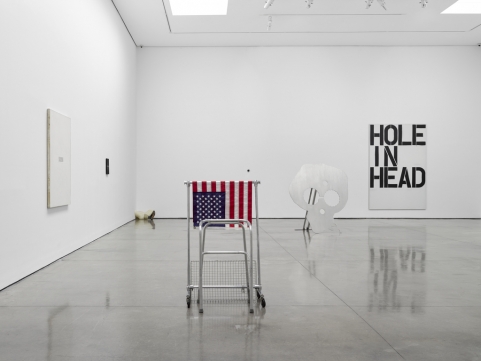
White Cube Ground Floor. October, 2017. From the Vapor of Gasoline, White Cube, Mason’s Yard, London, United Kingdom.
The emphasis on synergy is evident from the first view of the show. The gallery layout is such that the ground floor room is likely to be the first section one enters. Even before fully entering the room, Christopher Wool’s ‘Untitled (1989-1990)’, and Cady Noland’s ‘Untitled (1994)’ are visible due to their large size and prominent position. The works sit side by side on the far side of the entrance. The vantage point from the entrance to the room ensures that the works are digested simultaneously, with the word ‘RIOT’ from Wool’s work being implicitly linked to the symbol of the American flag from Noland’s. Acting like the introduction to an essay, these works prime the viewer for the rest of the show.
The marriage of these two pieces is strengthened in their shared use of material and shape, and through the creation of dialogue created through their respective colour palettes. Both artworks are rectangular and use aluminium as their primary support material. The shared material and shape create a shared visual commonality, but through their respective choice of colour, a secondary dialogue occurs. Wool’s piece shows blue letters reading ‘RIOT’ against a white backdrop and Noland’s shows a red flag against bare aluminium. Between them, they complete the red, white and blue pallet of the American flag, a palette which is so strongly associated with the American flag that it often acts as its designator. Thus only together do they seem to present a complete thesis. In this way, Wool’s ‘Untitled (1989-1990)’ becomes necessarily linked to the idea of the USA and Noland’s flag becomes necessarily linked to ideas of civilians and revolution. The tilted image of the American flag and ‘RIOT’ come together to create a feeling of an inverted USA with the threat of civil unrest hovering above it. Perhaps, the works do not offer a description of the USA, but a command: riot because the American symbol is a lie. These ideas of tension between official narrative and personal experience are echoed in various ways throughout the show.
In the lower ground floor, the synergy of work is once again evident. The works of ‘Wool’s Head’ (1992), Noland’s ‘Cowboy Bullethead Movie Star’ and Noland’s ‘Untitled (Walker)’ are linked through similar strategies as mentioned previously. While these works act as an opening statement to the room Barbara Kruger’s Untitled (Cast of Characters) (2016) offers a conclusion. ‘Untitled (Cast of Characters)’ (2016) is a digital print depicting words in uniform stencil, the stylistic quality of which links strongly to the works of Wool. Hung high, its large size, 152.4 x 304.8 cm (60 x 120 in.), and elevated position give it a status similar to that of an overseer, or factory foreman, viewing from a distance the machinations below. Each word on the print is a potential description of a person ranging from insulting to praising, although the praise seems barbed. The uniform style of the descriptions has a homogenising effect on their meaning. While the words mean different things, they are treated identically. The high hanging transfers this homogeny to the works in the room, saying, you are all ultimately the same.

Barbara Kruger, ‘Untitled (Cast of Characters)’, From the Vapor of Gasoline, White Cube, Mason’s Yard, London, United Kingdom.
This blanket effect is compounded by the near-incessant din of David Hammon’s ‘Phat Free’ (1995-1999), emitting the sound of tin drums. The sound is chaotic and is similar to the sound of industry. When images infrequently appear on screen, they are of scenes of African Americans in stark urban backgrounds, effectively bringing ideas of racial division in the USA into conversation. ‘Phat Free’ (1995-1990) creates a blanket acoustic back-drop for all the works in the room. The sound creates a mood of urgency that penetrates the entire room. The soundscape and the foreman-like effect of ‘Untitled (Cast of Characters)’ (2016) transmits a sense of great industry and the failures of humanity that come with it. The artworks operate in tandem to produce a sense of the indifference towards the common citizen
From the Vapor of Gasoline brims with unguarded anger at the status quo. To collect these works brings there message into the murky climate of ambivalence pervading the present. Through play, through words or through documentation, each work engages with its contemporary society, challenging it to be better. From the Vapors of Gasoline is charged with invisible riotous embers of dissent. Documented here is an anger with the world as it was. It provides a worrying, sobering view of the present as delivered from the past. But what is worrisome is not how relevant this anger is today – and it is – but how absent it is from our current life.
 Rafael Powell
Leave a comment