Published on The A R T S E I S T
Hyon Gyon
Parasol Unit Foundation For Contemporary Art, London 23 January – 31 March 2019
Rafael Powell
Bringing together paintings, sculptures and works that straddle that line, Gyon’s works are typically brightly-coloured, dark, disarmingly intimate windows into an unconscious world. Alive with fiery energy, the show’s feelings move uneasily through themes of dread, power and isolation.
Hyon Gyon’s show at Parasol Unit in East London showcases a selection of works from the last two years of the artist’s practice. Despite showing extensively in her home country of Korea, the show, eponymously titled Hyong Gyon, is the first solo exhibition of the artist in the UK.
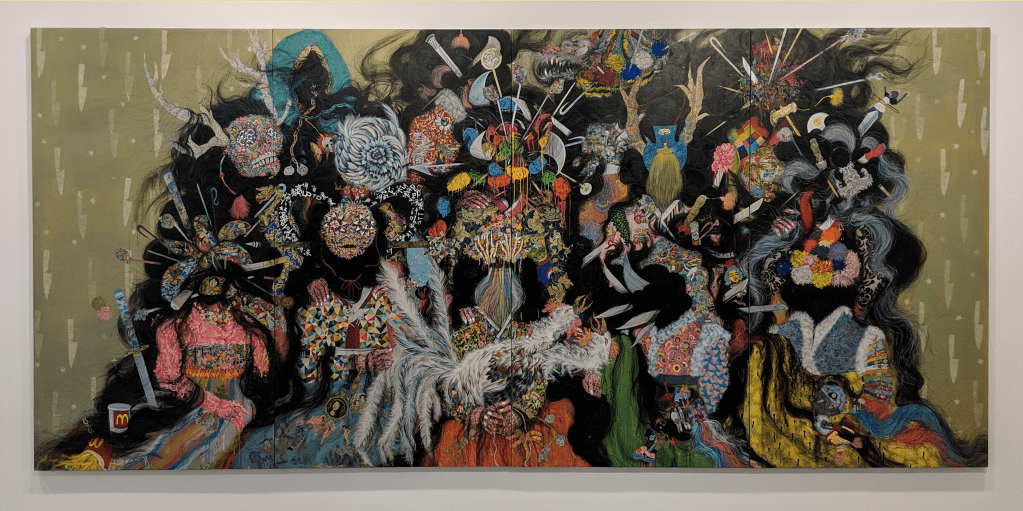
Hello Another Me (2010)
Through hallucinatory images and archetypical objects, Gyon’s dreamscapes present a confusing projection of the subconscious. In a world of demons, rainbow-fire, skull-faced girls and bleeding toys, the viewer has little choice but to approach the works as constructions of a subconscious dreamscape. Gyon’s work, despite its supernatural mode, is anchored in the domestic – a demonic family is still a family. In Hello Another Me (2010), a figure sits bottom centre of the four-canvas painting, a young girl. Her arms are crossed in her lap, as if posing for a photograph. Disembodied fiery hands rest on her shoulders. Tracing the image outward, within the storm of imagery behind, suggestions of other figures posing for the same photograph begin to manifest. Where faces appear, they are typically inhuman, demonic. Their sharp teeth glisten from Cheshire-cat mouths. Kaleidoscope eyes repeat indefinitely where sockets should be. The skin of these demons is comprised of flicks and licks of colour, either sick and blotchy, or made of structured flames. Gyon creates a scene of daily life obscured and distorted through supernatural presences, making the ordinary bizarre and overwhelming. Gyon provides a glimpse into a seemingly normal world, made terrifying in its unpredictability. The viewer is made ignorant, like a child trying to understand a threatening, confusing world.

Flame (2010)
Gyon has used fire as both a motif and a tool, linking a symbolic burning with the real-world process. Gyon’s use of the imagery of fire helps to construct a unified visual language where elements of one work inform the next. She does likewise with the leitmotif of hands that appear in several works. As fire spreads to everything around it, so does the motif dart from work to work within the show. In Flame (2010), a fire-faced demon set against a patterned green canvas shoots rainbows from its malformed body. It sits above three white-hot fires burning an assortment of portraits – a group of smiling Mickey Mice burn below the image of a man dressed as a school-girl. The blue flames of the demon’s face surround a multi-colored body of flicked-flames around the demon’s maw. In situ, the demon’s eyes look directly across the room at the epic We Were Ugly (2017), a massive 24-meter panel of oil paint, wood, styro-foam and fabric, all haphazardly burnt. The charred burnt plastic can almost be smelt against its foam backing. At various points in the painting, scenes emerge like a narrative in a frieze – a skull and crossbones, disembodied eyes, a ribcage. The fire permeates both real and unreal, like a dream that has broken into the physical world.
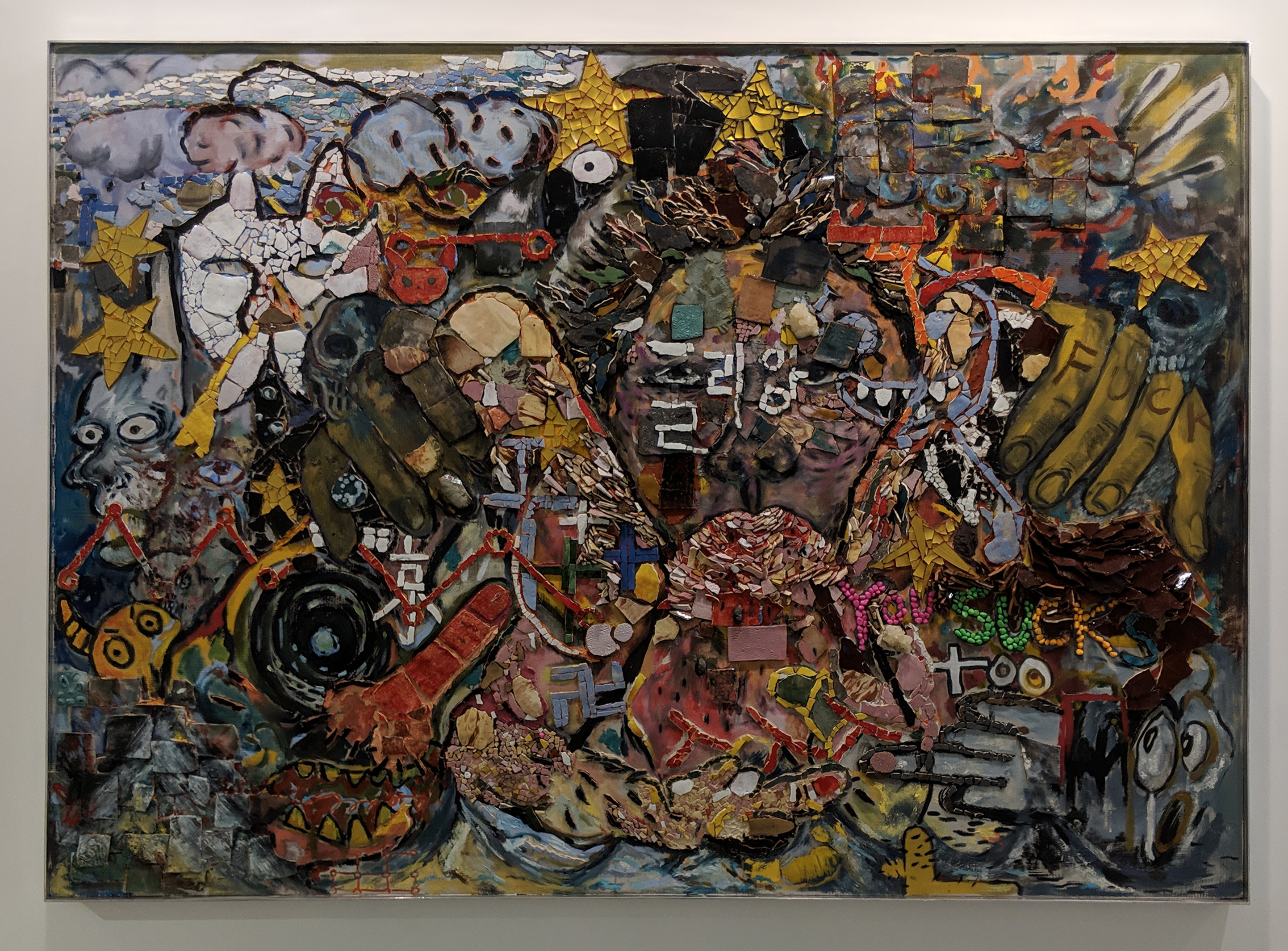
the boy named her oracle (2018)
Housed in the upstairs level, with other recent works is The boy named her oracle (2018). A chaotic collection of partial images constructed with mosaic crockery, stone and ceramic, embedded in paint. Marking a change in aesthetic for the artist, The boy named her oracle is chimeric, taking aspects of both painting and sculpture to become a separate entity entirely. Gyon has moved away from the miniscule brushwork of her earlier works. This is freer, rougher around its edges with the effect of becoming increasingly primal, urgent. The large size and multi-media construction of the work, combined with the tableau of partial images – a big-eyed face, a dog, a swastika, a dick that’s also a nose – makes it almost impossible to take the work in directly. Instead, cast it sideways glances, coming at it from the edges, building a mental map of the internal shapes as you go. Typical to Gyon’s past paintings, The boy named her oracle is an exploration of the subconscious collecting logically inconsistent thoughts and compositions. It does not represent an image but neither is it an abstract. It is a collection of ideas, some fully- formed, some not. The impressions gleaned are partial, constantly interrupted by new details, acting as a film still of a dream.
To write about Gyon’s paintings, or to view them through photographs does them a disservice. Words normalize the works, and photographs contain them, making digestible. In reality, the works are overwhelming. They force the viewer to retreat, examining tiny patches of territory, avoiding the vast theatre of the frame. The facade of Gyon’s paintings are constructed using details that make a whole. In this way, her paintings act like sub-conscious systems where, as noted by Fritjof Copra, ‘…the properties of the part can be understood only as a dynamic of the whole’ (Capra, Fritjof, “The role of physics in the current change of paradigms.” The world view of contemporary physics: Does it need a new metaphysics, 1988,p. 147). That is, that the parts only make sense when compared against their whole. Like Copra’s description of living systems, Gyon’s paintings are in flux, at least in the mind of the viewer. Like dreams, the whole is constructed through collections of fragmented details, changing depending on which details occur to the viewer. The vibrancy of the large format paintings, the thicket of references, denies a gestalt on which to grasp. And so they must be pieced together through cobbled visual fragments, piecemeal ideas. The approach to apply when trying to absorb them is experiential, not semantic. The works are less objects than experiences.
Hyong Gyon was born in Dangiin, Korea. In her undergraduate degree at Mokwon University, Gyon studied Western Painting before leaving for Japan to study a MA and PHD at the Kyoto city university., Gyon has had several shows in Japan and China, this is her first solo show in the UK. Her work is held in several notable museums, including the Brooklyn Museum. Hyon Gyon was on show at Parasol unit between the January 23rd and March 31st 2019.
 Rafael Powell
Leave a comment