Just off a not-so-busy-not-so-quiet road in East London, Julia Sullivan has transformed the façade of our flat into a viewing atelier. Visible from the street, the solo exhibition, Fine, I Guess (2020) brings together work created by Julia during the last 6 months. These include collages, paintings, lino and screen prints. In the context of the show, each work touches on the physical, social and cultural networks that form the scaffolding of public and private life during a period of shifting norms.
Displayed from home, in the midst of a global pandemic, the exhibition is a product of its time and place. The time is the days-eat-days world of Covid-19 lockdown. The place is two-fold. It is her home where the exhibition can only be viewed in situ by the local community performing the limited tasks that allow them outside. The second place is digital. It is the legion of primary and secondary apps and programmes that shuttle our attention and social presence to-and-fro. They carry us across myriad digital pathways like riding the network of public transport routes from bike-share to bus to trains under and over ground, navigated with seamless digital assistance. The two-fold space is not new, but locked-down life has removed the typically organic integration of the physical space and digital projection of self like geotagged selfies and social media I-was-there captions.
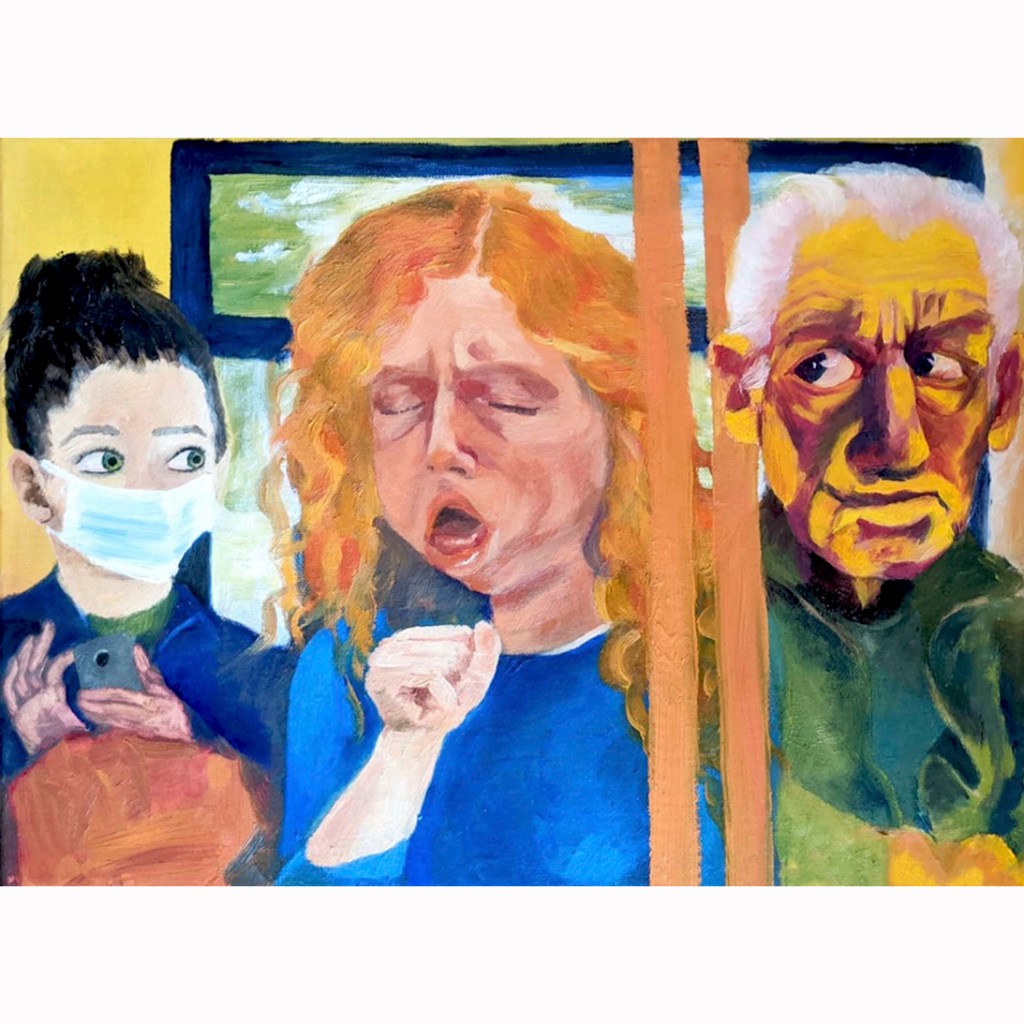
The combination of different levels of public systems coalesce neatly in Overground (2020). In the painting, a central figure seated on a carriage on London’s Overground Rail System coughs violently into her fist. A large-eyed woman with a face-mask looks from behind her phone screen, seemingly mid-scroll. A nervous older man sits on the right, his skin the complexion of a deep healing bruise. The mid-cough central woman, with her puffed cheeks and curly hair, is an inversion of Botticelli’s Zephyr, God of the West Wind, who blows gently from West to East. Our figure, instead, carries an east-blowing plague, bringing with it heightened international tensions and a disquieting creeping institutionally racist rhetoric – ‘The Chinese Virus’ among the most insidious. The concerned faces in the painting seem to expect what we have come to know, the coming wind heralds a new dawn: amalgamated days, locked-in lockdown with Zoom busts on LCD displays and glitched faces from low angles.
Overground presents a scene that months ago was mundane, but in the new normal is extravagant: human proximity, public transport, strangers! Likewise, En Air Plane (2019) captures a scene that has become both restricted and morally taboo. The Swedish word Flygskam is roughly translated as ‘flight-shame’, the feeling of shame derived from flying in a plane. As a point of view looking through an aeroplane window, a crescent coastline dividing city and sea, En Air Plane places the viewer in the air, complicit. In the current context, it carries a recognition that despite any flygskam, despite the fact that the ease of international travel is responsible for significant threat in our current environment, we all enjoy coming home.
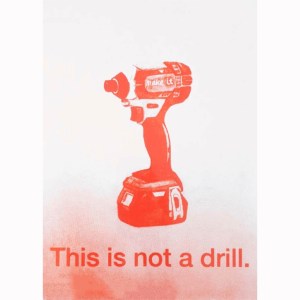
We know that this is the recession of the waters before the Tsunami rolls in, and yet for many there is respite to be gained from life slowed down. Between (oddly self satisfied) grim economic projections, stiff-upper-lip political bravado and decentralised opinion bases like twitter, it’s difficult to know what world we are looking at. What forms of industry, leisure, and life does the future hold? Mirroring this confusion, perhaps, is Julia’s work, Not a Drill (2019), a faded cautionary-orange screen-print of an impact driver and reference to Renè Magritte’s representation of a pipe. In semantic sleight-of-hand the work is not what it says it is and it’s not even what it says it’s not, a drill. It’s the representation of an impact driver, used for screwing screws and not drilling holes. It double-bluffs. It requires layers of knowledge to stay afloat in the game of deciphering its meaning. As far as talismans of an age go, it’s pretty apt.
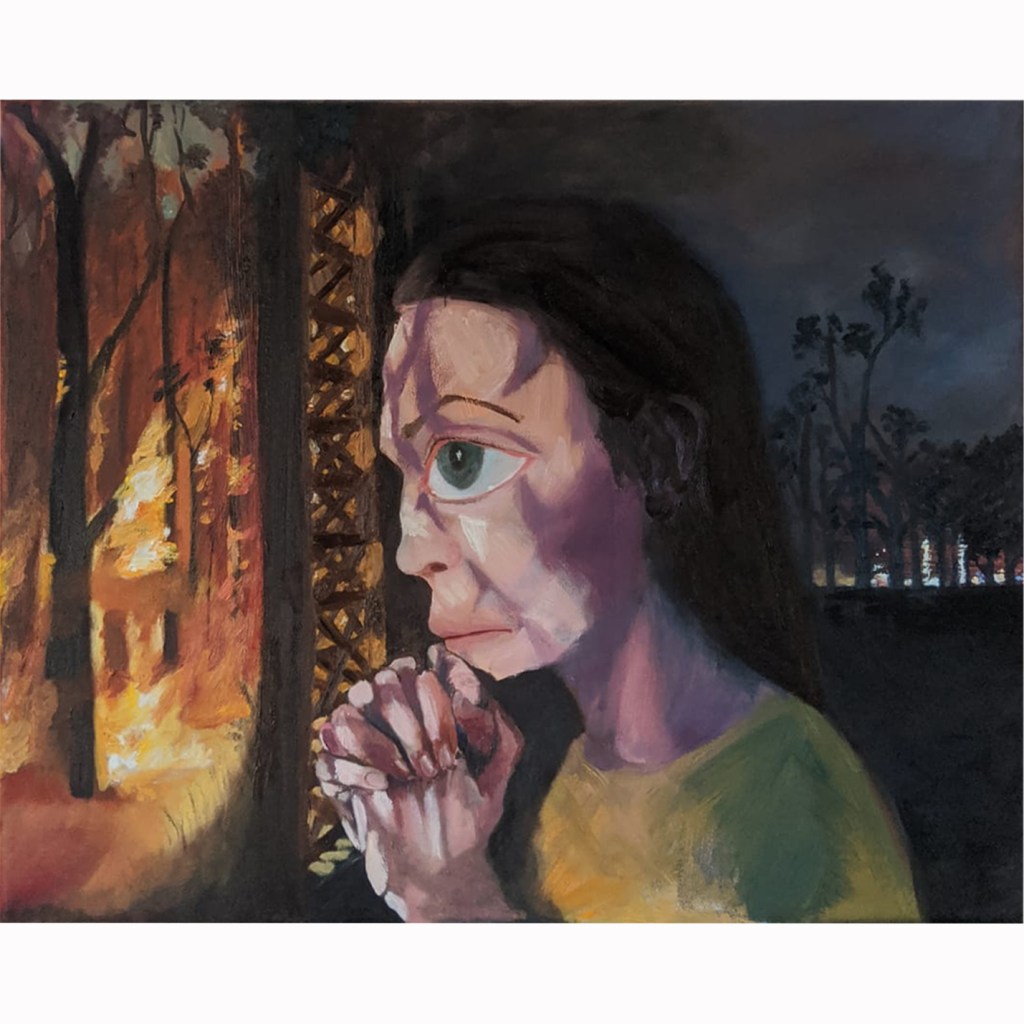
It is also not the only work that nods towards the impending cataclysm. Confession (2020), explores Julia’s relationship to the environmental world, a world she sees as under thread. As the eye scans the painting left to right, fires blaze into the night, a woman with a giant eye kneels in front of a latticed window and city lights twinkle behind a silhouetted row of trees. The woman kneels, wringing her hands, lips pursed in consternation. Her pose against the latticed screen paints her as a woman confessing her sins. The latticed screen draws from the Catholic confessional booth. In the mechanics of Catholic confession, forgiveness is granted by God after a catalogue of one’s sins, regardless of whether the confessor’s wrongs have been righted or their behaviour adjusted. Speaking with Julia about this piece, she talks about how it relates to our engagement as a species with ongoing environmental disaster. As she sees it, we forgive ourselves our roles in systems of climate change through our adoption of minor intervention, like banning plastic straws and wet wipes. We do this without deep acknowledgement of the roles we play in these networks of production and labour. Revealed through our period of Covid-19 quarantine is a worrisome truth. Even with decimated air-travel, reduced consumption and minimised living, our global carbon footprint is still too large to avoid dangerous levels of global warming. It is not a lifestyle change that must occur, but a structural change in production. But how can this happen? We are rendered complicit observers unable to effectively intervene and unable even to remove ourselves in a practical sense. Like the central woman, with eyes that are engorged on disaster, hands clasped, we wait for a miracle, or maybe forgiveness.
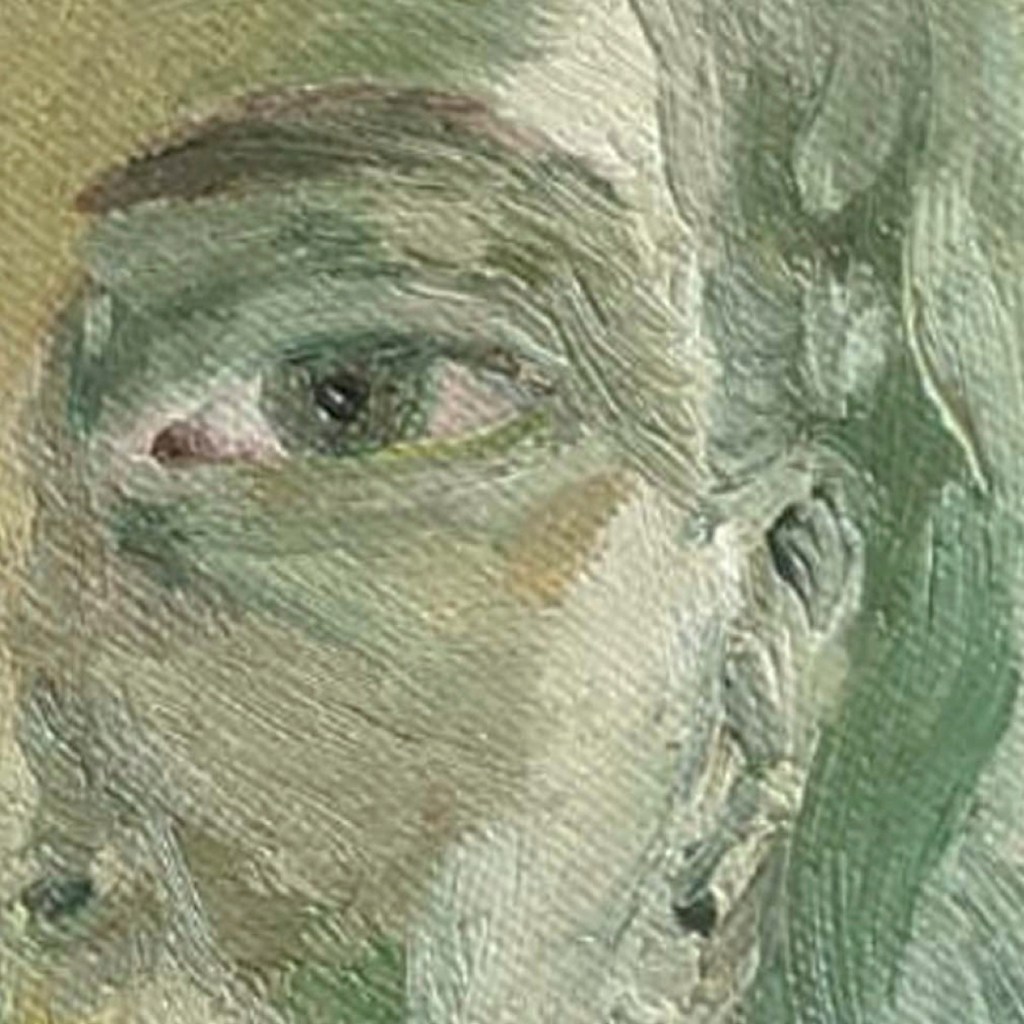
While Fine, I Guess explores Julia’s interactions with the outer world, it likewise digs into her relationship with herself. With Self-Portrait in Thermal (2019) and Self-Portrait in Leaf (2020), Sullivan presents two distinct avatars. In Self-Portrait in Thermal, using painted oranges, pinks and purples, she has painted an unforgiving formidable figure. Intense dark eyes look down on the viewer. The colour-scheme signals hot-blooded judgement, like the fires of judgement or hot-blood of anger. Self-Portrait in Leaf, painted in the colours of a damp forest floor, depicts a thoughtful young woman. She is unsure, exposed, and melancholy, but she is also resolved, staring directly at the viewer with living hair. As two nodes along a personal vector, the double-portraits present windows to the internal tunnels of a time worm.
I see the works as artefacts of time and place, straddling, like us, the pre-and-post Covid-cosm. They cohere to expose the now mutated networks that construct our distinct lived realities. The mutation is a form of self-healing. As time reveals, surprisingly few social and cultural networks, amorphous as they are, have been catastrophically compromised. We are still speaking and meeting up online. Art is still being loosed into the world. I still inexplicably feel guilt at missing exhibition openings or museum events. We still plan and dodge social engagements and call our parents to catch up. A symptom of these mutations is a discharged Art Institution, neutered through negation of physical spaces. Julia exploits this in the exhibition by operating outside an institutional setting. However, one of the fundamental strengths of the art institution has been to endlessly expand its frame of reference to include that which lies outside its walls[1]. And so, despite not being part of the art world’s lexicon, the show is absorbed by art world whole. Fine, I Guess is the inevitable gesture of an artist when the home has become studio, kitchen, bar, theatre, restaurant, psychiatric office, library and on and on ad infinitum. And that is fine too, I guess.
[1] This was noted first by Andrea Fraser in her seminal 2005 essay ‘From the Critique of Institutions to an Institution of Critique’, published by ArtForum International.
This essay was published in the catalogue essay for Julia Sullivan’s Solo Show from Home, an exhibition staged from flat windows during Covid-19-imposed nationwide lockdown. You can download the full catalogue with images and essay below.
 Rafael Powell
Leave a comment